
Prefer to listen? Play the audio version below.
Key Takeaways
- Every month a Florida PIP claim sits unresolved, the provider’s leverage decreases.
- Aging PIP receivables become harder to collect because documentation becomes harder to locate, verify, and use.
- Florida PIP deadlines can quietly eliminate otherwise valid claims.
- Delayed action can allow patient PIP benefits to be exhausted by other providers.
- Older receivables are more difficult to negotiate because carriers know the provider is working against time.
- A quarterly PIP audit can help medical providers identify unpaid, underpaid, downcoded, or improperly denied claims before the money becomes unrecoverable.
- Statutory PIP demand letters under Florida Statute 627.736(10) are often the difference between a collectible claim and a write-off.
The Hidden Cost of Waiting on Florida PIP Collections
After more than two decades of representing Florida medical providers in disputes under Florida Statute 627.736, the Florida PIP statute, I have developed a habit that no chiropractor, MRI facility, urgent care director, or orthopedic practice manager really wants to hear about. When a new medical provider sends me an aging report, I do not look at the dollar amount first. I do not look at the carrier first. I look at the date on the oldest unpaid claim. Because if you tell me how long that claim has been sitting in your accounts receivable, I can tell you, with disturbing accuracy, how much of it you are going to collect — and how much of it you have already, quietly, lost.
Let me be candid. In my experience, one of the greatest single threats to the profitability of a Florida practice that treats patients under Florida no-fault insurance is inaction and self-delay. Yes, there are other real threats out there: unethical insurance carrier tactics, misused and abused fee schedules, relentless downcoding, improper utilization review, and claim denials that seem designed to wear providers down. But at the end of the day, a medical provider’s enemy can also be the calendar.
Every month a PIP claim ages in your system, your leverage shrinks, your supporting documentation degrades, and your statutory rights quietly erode. By the time most practices realize what has happened, the money is already gone, and there is no realistic way to get it back. This is the hidden story of Florida PIP collections, and it is one every medical provider treating accident patients in this state needs to understand.
Request a FREE PIP Audit
Think your practice may be losing money to unpaid, underpaid, or improperly denied Florida PIP claims? Fischetti Law Group can review your aging report, identify recoverable claims, and determine which files may need immediate PIP demand letters.
Request a FREE PIP Audit today and find out what may still be collectible.
The First Thing You Lose Is the Paper Trail
Imagine a busy chiropractic clinic in Tampa. The owner — call him Dr. M — treats twelve to fifteen PIP patients a day and runs a tight ship at the front desk. Claims go out within fourteen days. But when the EOBs come back with denials, downcodings, or partial payments, they go into a pile labeled “to review later.” The owner means to get to them. He really does.
Six months later, a carrier sends an unfavorable EOB on a $4,800 course of treatment. By then, the front desk staffer who did the intake is gone. The intake form is in a banker’s box in the back room. The HCFA 1500s are still reproducible from the EMR, but the police report, the patient’s recorded statement, the disclosure and acknowledgment form, the assignment of benefits, and the proof of mailing on the original claim are scattered across three different files — if they exist at all.
When I receive a file like that in my office, the first thing I have to do is rebuild it. Rebuilding a stale PIP file is expensive, time-consuming, and sometimes impossible. The longer you wait to challenge a denial, the more your medical provider PIP billing paper trail decays. Staff turn over. EMR vendors migrate to new platforms. Servers crash. Faxes disappear. Letters are scanned but misfiled. Long-time billers retire. The carrier knows all of this. They are counting on it.
Common missing or weakened documents include:
- Assignment of benefits
- Disclosure and acknowledgment forms
- Proof of mailing
- EOBs and denial letters
- HCFA/CMS-1500 forms
- Police reports
- Patient intake documents
- Treatment notes and supporting records
The job of a PIP adjuster becomes dramatically easier every month you sit on a denial, because every month I have less paper to throw back at them in a Florida PIP demand letter.
Why Documentation Matters in Florida PIP Collections
In Florida PIP collections, documentation is not just administrative support. It is the evidence file. Your records help prove that the bill was timely submitted, the services were connected to the accident, the documentation supports medical necessity, the assignment of benefits was valid, the carrier received the claim, and the denial, reduction, or underpayment was improper.
When those documents disappear, become incomplete, or are difficult to reconstruct, a collectible PIP claim can quickly become a practical write-off.
The Second Thing You Lose Is the Deadline
Florida no-fault insurance law is unforgiving on timing. Unless a bill falls under a narrow exception, it must be submitted within thirty days. The PIP statute of limitations in Florida is five years from breach of contract — and five years sounds like a long time only until you are staring at a 2021 date of service in 2026 with no demand letter on file and a carrier who is, predictably, refusing to negotiate in good faith.
I had a case last year that I think about often. An MRI facility in Broward County — well-run, with excellent radiologists — came to us with $312,000 in aged PIP receivables. About $74,000 was within two years old. Another $108,000 was three to four years old. Roughly $130,000 was already outside the statute of limitations, or close enough to it that no reasonable PIP claims attorney in Florida would take the file on a contingency basis.
The owners genuinely believed they had years to deal with it. They did not. They had inadvertently donated $130,000 to the carrier’s loss reserves. The brutal arithmetic of the PIP statute of limitations is that it runs claim by claim, date of service by date of service. Every week you wait, another batch of dollars walks off your aging report and becomes unrecoverable.
Why PIP Aging Reports Should Be Reviewed Regularly
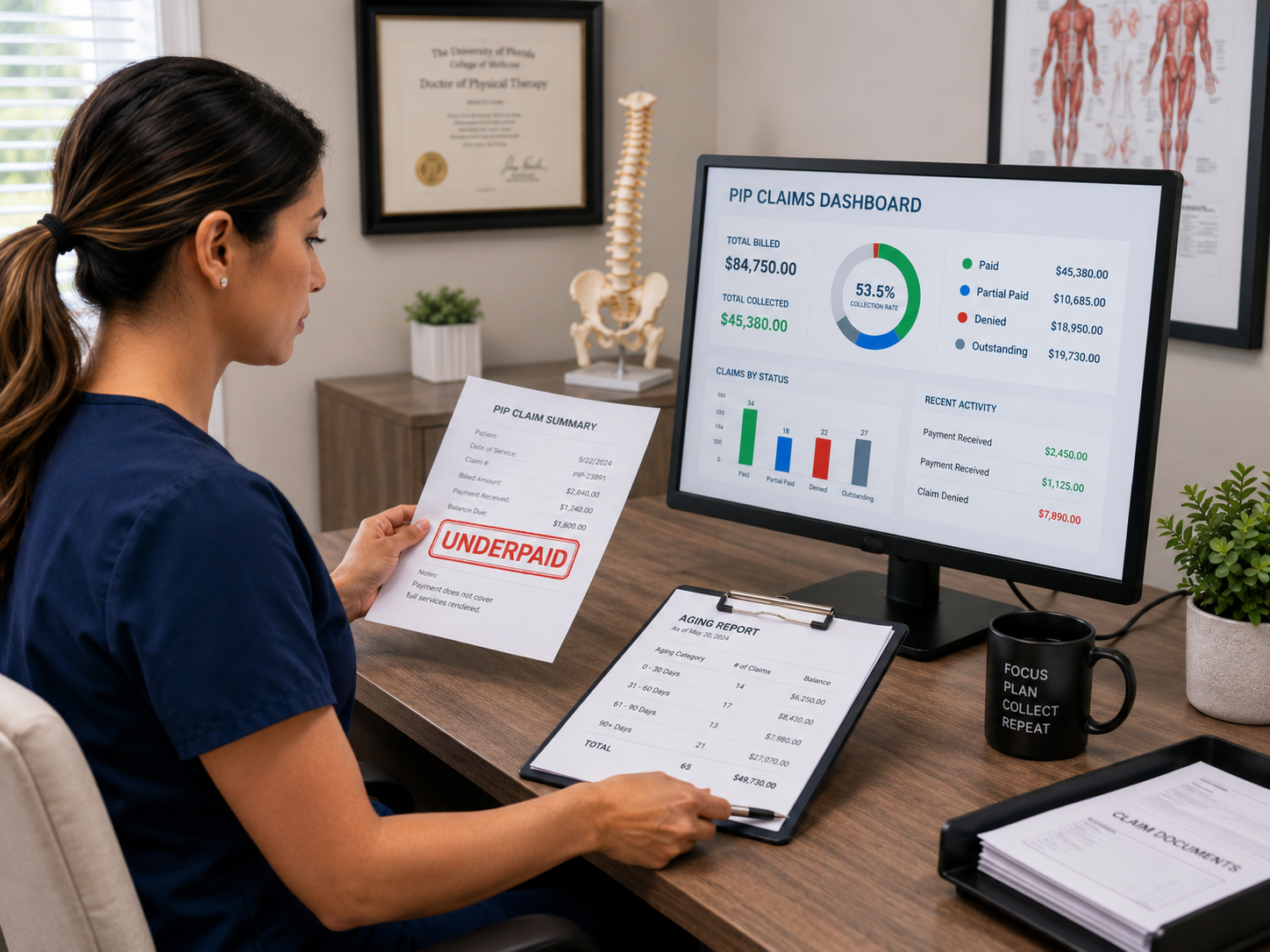
A profitable Florida PIP practice cannot treat the aging report like a historical document. It has to be treated like a warning system. Your aging report should show which claims are unpaid, which claims were underpaid, which claims were downcoded, which claims were denied, which claims are approaching statutory deadlines, which claims need a Florida PIP demand letter, and which claims may already be compromised by delay.
If your practice only reviews aged receivables once a year, you are probably reviewing some claims after the best recovery window has already closed.
The Third Thing You Lose Is the Patient’s PIP Benefits
This one is the cruelest, and it is the one most providers misunderstand. Florida PIP benefits are finite. Each injured patient typically has a $10,000 pot — sometimes only $2,500 if the carrier classifies the injury as non-emergent. That pot is paid out on a first-come, first-served basis. The carrier pays whoever bills cleanly, completely, and aggressively. When the pot is empty, every other provider treating that same patient is competing for zero dollars.
Consider an urgent care center in Orlando that sees an auto accident patient on the day of the crash and bills $1,400 promptly. Two weeks later, that same patient lands in a chiropractor’s office for an active treatment plan. Four weeks after that, an orthopedic specialist evaluates her. Eight weeks after that, an MRI is finally ordered. If the urgent care, the chiropractor, and the orthopedist all pursue PIP billing aggressively and chase down every denial, they will steadily eat through the patient’s available PIP benefits.
By the time the MRI bill is submitted, PIP benefits exhaustion is the carrier’s polite way of telling the radiology group, “There is nothing left.” The MRI facility has a perfectly valid bill, perfectly compensable treatment, and absolutely no PIP money to collect against. Their only remaining options are bodily injury liens, third-party liability recovery, or writing it off — and none of those are as clean, fast, or reliable as a timely PIP demand.
In Florida PIP Collections, the Providers Who Move First Often Win
The providers who win in Florida PIP collections are simply the ones who get to the front of the line. Period. Aggressive billing is not unseemly. It is survival. When your competitors are sending out PIP demand letters and you are not, you are quite literally subsidizing their profitability with your own patients’ benefits.
That is not a billing problem. That is a business problem. And it can be fixed.
The Fourth Thing You Lose Is Your Negotiating Leverage
Carriers are sophisticated. Their adjusters have aging reports too. When I send a Florida PIP demand letter under 627.736(10) on a claim that is sixty days old, the carrier knows the file is fresh, the records are intact, the witnesses are reachable, and a lawsuit will be filed in short order if they do not pay. They behave accordingly. They settle.
When the same demand is sent on a claim that is three years old, the adjuster understands that the provider has effectively told them, by inaction, that the money is not a priority. They offer thirty cents on the dollar — or nothing — and dare you to litigate.
I represented an orthopedic group last year whose office manager called me in a panic because their accounts receivable had crossed $600,000. We sorted the file by age. On claims under one year old, we recovered more than ninety percent of billed charges, including statutory interest, postage, and attorney’s fees. On claims one to two years old, the recovery rate dropped to roughly seventy percent. On claims older than that, the recovery rate fell off a cliff — not because the law had changed, but because the carriers knew we were working against the clock and against degraded evidence.
The age of the receivable was, by far, the single biggest predictor of recovery. Not the diagnosis. Not the carrier. Not the procedure code. The age.
Older PIP Claims Are Harder to Collect
The older a Florida PIP receivable becomes, the more problems appear. Records may be missing. Staff may no longer be available. Proof of mailing may be harder to locate. Claim histories may be unclear. Benefits may be exhausted. Deadlines may be expired or approaching. Settlement leverage may be lower. Carrier defenses may become more aggressive.
That does not mean every older claim is worthless. But it does mean that delay changes the economics of recovery. A claim that may have been highly collectible at sixty days may become heavily discounted at three years. A claim that may have justified a statutory demand at six months may become a practical write-off by the time the provider finally decides to act.
Request a FREE PIP Audit
Unpaid or underpaid PIP claims only matter if they are still collectible. Fischetti Law Group can review your aging report and identify claims that may need statutory PIP demand letters.
Find out which claims may still be collectible before more money disappears from your receivables.
What a Profitable Florida PIP Practice Actually Looks Like
A profitable PIP practice does not have to be glamorous. It looks like a clean ledger, an organized aging report, and a standing internal rule that no denial sits more than thirty days without a written response. It also looks like a practice that has trained its biller to recognize a 627.736 violation when it appears, including:
- Improper application of the fee schedule
- Improper utilization review
- Downcoding without a stated basis
- Denials that fail to comply with statutory requirements
- Failure to provide a reasonable proof of loss explanation
- Unpaid or underpaid claims that should be escalated
- Patterns of carrier delay or improper reduction
Most importantly, it looks like a practice that uses an outside Florida PIP claims attorney as a partner, not as a last resort.
The Quarterly PIP Audit Model
The easiest and most effective way to build that practice — the approach I recommend to every chiropractor, MRI facility, urgent care, and orthopedic group that walks through our door — is boringly simple. You schedule a quarterly PIP audit with Fischetti Law Group. We review your aging report. We identify every claim that has been improperly denied, underpaid, downcoded, or ignored. And we send formal PIP demand letters under Florida Statute 627.736(10) on every single one of them. Four times a year. Like clockwork.
That cadence does three things no internal billing department, no matter how good, can reliably replicate on its own.
1. It Keeps Your Documentation Fresh
We are pulling and reviewing files while staff still remembers the patients, while records are still accessible, and while the paper trail is still easier to reconstruct.
2. It Keeps the Statute of Limitations Clock Visible
A quarterly audit flags aging claims long before they expire. It helps prevent recoverable revenue from quietly becoming unrecoverable.
3. It Puts Carriers on Notice
Once a quarter, the carriers are reminded that your practice is not a soft target. Adjusters talk to each other. Once your tax ID is associated with consistent, well-supported 627.736(10) demands, your downcoding rate begins to fall on its own. I have watched it happen in practice after practice.
The Conversation I Have With Every New Medical Provider Client
I will tell you what I tell every provider who calls our office for the first time, slightly embarrassed about the size of their aging report. There is no shame in a stale receivable. There is only the question of what you are going to do about it today. Every week you wait, the carrier wins a little more. Every week you act, you take a little back. The math is that simple. And so is the fix.
If you treat patients under Florida no-fault insurance — if your practice depends in any meaningful way on Florida PIP collections — you are almost certainly leaving a significant amount of money on the table right now. Not because you are doing anything wrong, but because the system is designed to reward whoever moves first. Fischetti Law Group exists to make sure that whoever moves first is you.
Frequently Asked Questions About Florida PIP Collections
Request a FREE PIP Audit
You treated the patient. You submitted the bill. Now make sure the carrier pays what it owes. Fischetti Law Group helps Florida medical providers pursue unpaid, underpaid, delayed, downcoded, and improperly denied PIP claims under Florida Statute 627.736
Request a FREE PIP Audit today and find out how much revenue may still be collectible from your aging report.