
Prefer to listen? Play the audio version below.
Key Takeaways
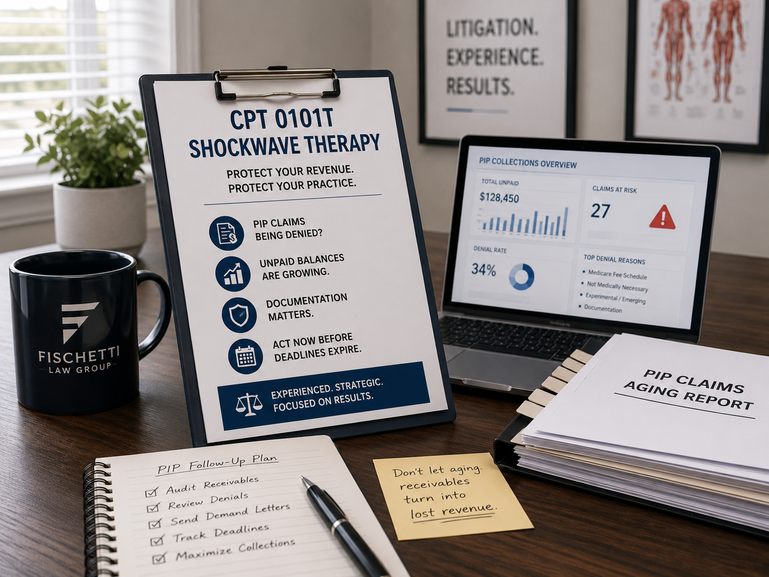
- CPT 0101T shockwave therapy is becoming a major new battleground in Florida PIP collections.
- Progressive and Allstate are increasingly denying CPT 0101T based on Medicare fee schedule arguments.
- The absence of a Medicare-published fee does not automatically mean a medically necessary service is not reimbursable under Florida PIP.
- Peer reviews and IMEs are creating additional risk by attacking the medical necessity and frequency of shockwave treatment.
- Providers using ESWT need clean, contemporaneous documentation showing why shockwave was chosen, when it was chosen, and what measurable improvement it produced.
- Quarterly PIP audits can help identify unpaid shockwave claims, carrier denial patterns, and recoverable balances before deadlines expire.
- Statutory PIP demand letters under Florida Statute 627.736(10) are critical for preserving collection rights and escalating unpaid claims properly.
Why CPT 0101T Shockwave Is Becoming a Florida PIP Collections Issue
For more than two decades I have represented Florida medical providers in disputes with PIP insurance carriers under Florida Statute 627.736. In that time I have watched insurers cycle through one denial theory after another. First it was passive modalities. Then it was therapeutic activities billed alongside therapeutic exercise. Then it was MRI utilization, then manual therapy units, then trigger point injections.
The new front line, and the one that is quietly producing some of the largest accounts receivable balances I have seen on a provider’s books in years, is extracorporeal shockwave therapy billed under CPT code 0101T.
If your practice is providing shockwave to PIP patients, you need to understand what is happening, why it is happening, and what to do before the unpaid balance on your books becomes too large to recover.
Request a FREE PIP Audit
Unpaid or denied CPT 0101T shockwave claims may be part of a larger carrier denial pattern.
Fischetti Law Group can review your aging report, identify disputed shockwave claims, and determine which files may need statutory PIP demand letters.
Find out what may still be collectible.
What Shockwave Therapy Is and Why Medical Providers Are Using It
Extracorporeal shockwave therapy, often shortened to ESWT, delivers acoustic pressure waves into musculoskeletal tissue to stimulate a healing response. The clinical theory is well established. The mechanical energy promotes neovascularization, modulates inflammatory mediators, breaks up calcific deposits, and accelerates collagen remodeling in tendon and soft tissue.
Peer-reviewed studies in journals such as the American Journal of Sports Medicine and the Journal of Orthopaedic Research have supported its use for plantar fasciitis, lateral epicondylitis, chronic tendinopathy, and a growing list of post-traumatic soft tissue conditions, which are exactly the kind of injuries an auto accident produces.
In a typical protocol, a provider administers three to six sessions spaced approximately one week apart, with reassessment after the initial series to determine whether additional treatment is justified. It is non-invasive, requires no anesthesia, and for the right patient it can meaningfully reduce reliance on injections and opioids.
That is precisely why chiropractors, orthopedists, urgent care centers with sports medicine arms, and even some MRI and diagnostic facilities have folded shockwave into their post-accident care pathways.
The CPT Code Behind the Fight: 0101T
The CPT code that captures all of this is 0101T, a Category III “emerging technology” code maintained by the AMA. That last word, emerging, is the hook insurers are using to refuse payment, and it is the reason every provider reading this should pay close attention.
Why Progressive and Allstate Are Denying CPT 0101T
The argument coming out of Progressive and, increasingly, Allstate is straightforward in structure even if it is wrong on the merits. They take the position that because CPT code 0101T has no assigned value on the Medicare Physician Fee Schedule, it is by definition not reimbursable under Medicare, and therefore not reimbursable under Florida’s PIP statute.
They cite the fee schedule limitations in Florida Statute 627.736(5)(a) and argue that an item with no Medicare allowable simply has nothing to pay. We are seeing this denial language come back almost verbatim on explanation of benefits forms, with phrases like “not reimbursable under Medicare Part B” or “no allowable fee on file,” and the AR sitting on provider books is climbing accordingly.
Most other PIP carriers in Florida are still paying CPT 0101T, but I have to be candid with my provider clients. The denials are no longer isolated. We are getting sporadic refusals from carriers who paid the same code six months ago, which tells me the industry is testing the waters.
If Progressive and Allstate win this fight in enough county courts, every other carrier will likely follow within a quarter.
Common CPT 0101T Denial Language Providers Are Seeing
Medical providers billing CPT 0101T should watch for denial language that includes:
- “Not reimbursable under Medicare Part B”
- “No allowable fee on file”
- “No Medicare fee schedule value”
- “Emerging technology”
- “No reimbursement due under the applicable fee schedule”
- “Service not payable under Florida PIP”
These explanations should not simply be written off. They should be reviewed as part of a broader PIP collections strategy, especially if the same denial language appears across multiple patients or carriers.
The Provider Counter-Argument Under Florida PIP
The counter-argument, in plain terms, is that the PIP statute requires payment of reasonable charges for medically necessary services lawfully rendered. The absence of a Medicare-published fee does not make a service non-reimbursable. It simply means the fallback methodology in 627.736(5)(a) controls and a reasonable charge analysis applies.
Florida appellate courts have already addressed analogous Category III code disputes in other contexts, and the prevailing weight of authority supports the providers. But “prevailing weight of authority” is a courtroom phrase, and getting there requires actually filing suit, surviving motion practice, and putting on competent expert testimony.
That is where many providers lose the war even when they are right on the law.

Request a FREE PIP Audit
You provided the treatment. You billed the claim. Now make sure the carrier pays what it owes.
Fischetti Law Group helps Florida medical providers pursue unpaid, underpaid, delayed, downcoded, and improperly denied PIP claims, including disputed CPT 0101T shockwave claims.
Review your unpaid shockwave claims before they become lost revenue.
The Peer Review and IME Problem You Cannot Ignore
There is a second front opening alongside the Medicare-based denials, and it is more dangerous because it attacks the medical necessity of the treatment rather than the price of the code.
Carriers are commissioning peer reviews that flag shockwave as overutilized. Boldly stating that six sessions is too much when three would have sufficed, bilateral treatment when the documentation only supports unilateral complaints, or repeated series without an interval reassessment that demonstrates measurable improvement.
I have seen peer review opinions written by physicians who have never personally administered ESWT but who nonetheless opine, with confidence, that the provider in front of them used too much of it.
Then there is the independent medical examination problem. In Florida PIP practice, an IME does not just adjust future payment for one disputed modality. Under the statute, an unfavorable IME can be used to cut off all future medical benefits across every provider treating the patient.
I have had clients lose six-figure receivables not because their shockwave billing was wrong but because an IME doctor decided the patient had reached maximum medical improvement on the day of the exam, and every provider downstream got an across-the-board denial.
If shockwave is in the patient’s treatment plan and the IME doctor is hostile to it, the entire course of treatment becomes vulnerable in a single afternoon.
Why Shockwave Documentation Matters Before Peer Review or IME
For providers using ESWT in PIP cases, documentation should be built as if it will eventually be reviewed by a hostile carrier, a peer reviewer, an IME physician, and a judge.
Strong shockwave documentation should show:
- The patient’s accident-related diagnosis
- The conservative care attempted before shockwave
- The clinical reason ESWT was selected
- Baseline pain scores and objective findings
- Functional limitations before treatment
- Treatment frequency and protocol
- Reassessment after the initial sessions
- Measurable improvement or lack of improvement
- The reason treatment was continued, modified, or stopped
- Clinical literature or recognized rationale supporting the treatment plan
The cleaner the record, the harder it is for a carrier to reduce the dispute to “experimental,” “overutilized,” or “not medically necessary.”
A Hypothetical That Plays Out Every Week in Our Office
Consider Dr. A, a chiropractor in Broward County who treats a patient injured in a rear-end collision. The patient presents with cervical and lumbar strain, develops persistent lumbar tendinopathy at the gluteal insertion, and after four weeks of conservative care Dr. A introduces shockwave at the affected site.
He performs six sessions over six weeks, bills CPT 0101T appropriately, and documents pain scores, range-of-motion measurements, and functional progress before and after each session.
Progressive is the PIP carrier. Progressive denies every shockwave charge as “not reimbursable under Medicare.” Six months later Dr. A is sitting on roughly five thousand dollars in unpaid shockwave billing for that single patient, and he has nineteen other Progressive patients in the same posture.
His AR exposure on this one carrier alone is just under one hundred thousand dollars, and that is before he even counts the rest of his denied modalities.
This is not a hypothetical I made up to be dramatic. These are composites of similar fact patterns that come into our office every month.
Review Your Shockwave AR Before It Becomes a Write-Off
If CPT 0101T denials are sitting in your accounts receivable, the question is not just how much is unpaid.
The better question is how much is still recoverable.
Fischetti Law Group can review your shockwave-related PIP receivables, evaluate carrier denial language, and identify claims that may need immediate statutory demand letters.
Review your aging report before unpaid shockwave claims become lost revenue.
How to Document Shockwave So You Can Actually Win
The cases that prevail in court, and the demands that get paid before suit is ever filed, share a common feature: clean, contemporaneous, defensible documentation of why shockwave was chosen, when it was chosen, and what it produced.
That means a clinical rationale in the chart that explains why this patient, with this diagnosis, after these prior conservative measures, is a candidate for ESWT. It means baseline objective measurements before the first session and reassessment data after each subsequent session.
It means a clearly recorded decision point, usually after session three, at which the provider either continues, modifies, or terminates the protocol based on the patient’s response. And it means references in the chart to the clinical literature the provider relied on, because when a peer reviewer challenges the necessity, your strongest answer is a record that already shows you applied a recognized clinical framework rather than reaching for a billable code.
Jurisdiction Matters in Florida PIP Shockwave Litigation
The jurisdiction matters too. What survives motion practice in a Miami-Dade county court may not survive in Duval, and a strategy that wins in front of one circuit judge can lose in front of another. A methodical, precise approach, tailored to where the case will actually be tried, is the difference between a paid demand and a five-figure write-off.
Be Careful Who Handles These Files
This is also the place where I have to be direct with providers about something else. Do not hand these files to the first PIP attorney who knocks on your door promising fast money and a contingency that sounds too good to be true.
The Florida PIP bar has a long tail of high-volume, fly-by-night operators who will file your suits, lose your motions, and in the worst cases expose your practice to a prevailing-party attorney’s fee award against you under the right combination of offers of judgment and statutory provisions.
Shockwave litigation in particular requires expert witness coordination, careful pleading of the Medicare fee-schedule fallback argument, and jurisdiction-specific strategy. This issue will ultimately be decided by the appellate courts, and the cases that build the favorable record will be the ones tried by attorneys who understand both the statute and the science.
The Quarterly PIP Audit: How to Stop Leaving Money on the Table
The single most effective step a Florida medical provider can take right now is to stop treating PIP collections as a back-office afterthought.
The unpaid balance on shockwave alone, across the carriers we see denying it, is large enough at most practices to fund a full-time staff position.
Fischetti Law Group offers our provider partners a quarterly PIP audit in which we pull your aged receivable, identify every carrier, every denial code, and every claim still within the limitations period under Florida Statute 627.736, and we send statutory PIP demand letters under 627.736(10) on the recoverable balances.
The demand process alone, properly executed, recovers a meaningful percentage of the file before a single complaint is drafted, and it preserves your right to sue on the balance.
What a Quarterly PIP Audit Helps Identify
A quarterly PIP audit can help Florida medical providers identify:
- Unpaid CPT 0101T shockwave claims
- Repeated carrier denial patterns
- Improper Medicare fee schedule objections
- Downcoded or reduced claims
- Claims approaching statutory deadlines
- Files needing immediate demand letters
- Documentation gaps that may weaken recovery
- Claims that may require litigation strategy
- Recoverable balances before they become stale receivables
For providers using shockwave therapy in PIP cases, this is no longer just a billing cleanup issue. It is a collections, compliance, documentation, and litigation-readiness issue.
Frequently Asked Questions About CPT 0101T Shockwave and Florida PIP Collections
The Bottom Line for Florida Medical Providers Billing CPT 0101T
If you are reading this and you have shockwave claims sitting unpaid with Progressive, Allstate, or any other carrier, the worst thing you can do is wait. The statute will run. The peer reviews will pile up. The IMEs will be scheduled.
Call our office. Let us run the audit, send the demands under Florida Statute 627.736(10), and recover the money your practice has already earned, on shockwave and on every other code those carriers are quietly denying.
That is what we do, and after more than twenty years of doing it, I can tell you the providers who treat their accounts receivable with the same rigor they treat their patients are the ones who will survive what is coming.
Request a FREE PIP Audit
You treated the patient. You submitted the bill. Now make sure the carrier pays what it owes.
Fischetti Law Group helps Florida medical providers pursue disputed CPT 0101T shockwave claims and other unpaid or underpaid PIP balances.
Request a FREE PIP Audit and find out what may still be collectible.